
Samurai Horseback Archery in Japan
Destination
Nikko, Japan
Operator
Shogun Stables
When I Went
October 2025
Duration
3 hours
Price
48000 yen (about $250)
Price above for 3 hour Kyudo and Yabusame experience. There are also some other experiences - a 2 hr mounted archery only for 28000 yen, for example.
Experience Type
lesson, cultural
Rider Level
Beginner
Best Season
spring, summer, fall
Overall Rating
Quick Verdict
Yabusame and Kyuodo (Samurai horseback archery) at Shogun Stables offers a fascinating glimpse into an 800-year-old warrior tradition in stunning Nikko, Japan. They offer a variety of classes in samurai etiquette, archery and/or mounted archery. The stables have been training samurai warriors for the past 800 years and participate in the shrine's ceremonies with their sacred horses, so you'll get an introduction from the real deal at this center.
The Experience
Background & Booking
For some background, I've done horse archery before. I did two weekend clinics with Elizabeth Tannen in Pennsylvania and New Jersey (highly, highly recommend!). Unfortunately no horse archery clubs exist close enough to NYC for me to practice regularly but I do occasionally try to get better at shooting arrows by going to lane practice sessions at Gotham Archery. I'd say I'm a beginner but not a newbie and I knew going into this experience that Japanese archery is very different from what I learned in North America so very little of what I had learned would likely be applicable in Japan.
A few days before the date, I was contacted by email asking about my weight and height for my outfit, and told that, despite being experienced, I would be limited to the walking session. They mentioned that in case of rain, they had a wooden horse experience in place of the live horse archery. Rain was in the forecast, and it was too late to get a refund, so I prayed it would be nice enough to ride, because I had really little interest in spending three hours on a wooden horse. Fortunately my prayers were answered, and the sky was clear and the sun was shining after a very long downpour the day before.
Arrival & Setting
I was greeted by one of the head instructors who showed me the way to the academy grounds. We passed by a few turnout paddocks with horses. Yay! They turn their horses out! I was worried after seeing a sacred horse by itself stuck in a small stall inside a shrine building the other day neighing desperately. It almost made me call the thing off thinking the horses might be treated the same way here but fortunately they at least have friends and turnout time.
I have to call out the overall setting here as a brief sidenote - Nikko, Japan, is absolutely gorgeous. It's a mountainous region that is especially famous for bright fall foliage, but even without that, it's a beautiful landscape full of verdant mountains, peaceful streams turning into mighty waterfalls, famous hot springs, and resort-laden lakes surrounded by crisp, clean air. In Japan? Definitely check Nikko out if you love mountains and nature. In Nikko? I suggest going up towards the Lake Chuzenji area as well as it took what I thought was a lovely landscape around Nikko and brought it up to a 10!
We passed a beautiful, small Japanese garden with moss and a small brook and arrived at the building that seemed to serve as the archery academy. There were half a dozen people there already. Initially, I assumed some of the other participants had arrived early. But no… it turned out that the entire session would be just me, with everyone else watching! I was told they were students, and a few of them did demos over the next two hours, one took a lot of photos and videos on my phone, and one was translating (the translation was such a relief!). For a very socially awkward person like myself, this was not ideal - I really had assumed I'd be joining a group and instead had all the attention of 6 focused on me for the next 2 hours.
Dressing & History
The first part of archery was dressing the part. Dressing took some time as it was very elaborate (a top, overpants, belt, sash). Then I watched a short video about the history of the school. It turns out that Yabusame was part of Samurai warrior etiquette that became part of Samurai training many centuries ago and has been passed down and practiced since. Shogun stables also does rituals for the nearby shrines at Nikko, which are some of the most important in Japan and thus have very important festival celebrations (unfortunately, I missed one of them by only a day!).
Learning the Rituals
After the video, we started by learning how to bow properly. I wasn't exactly graceful at this part — and I'll admit, perfecting the Samurai bow probably isn't in my future although it did make me hyper aware of the need to continue working on my posture once I got back home.
Afterwards, we moved on to picking up the bow. Like bowing, this also had a lot of rituals. One starts with a large step left, medium step right, large step left; the width of the stance has to be exactly right, etc. My stances also had my toes pointing too far outward. We were now almost ready to shoot a real arrow, but first, I needed to show I could do it on a small fake rubber bow. I passed with flying colours - could I now shoot the real arrows? Not yet! First, we needed to learn the proper breathing rituals before drawing the bow. At a horse archery competition, you've got seconds between targets so I don't think I'll be taking five breaths to analyze the state of my string. But it does make you look like a really wise/zen warrior.
Shooting Practice
And then it was time to shoot! I was ok at the short-distance practice but could not get the long-distance one. As I said, I'm not really that great of an archer. But for some reason the teacher rushed through this part even though later we ended really early, so I'm really not sure why. At this point, a break was proposed, but it didn't happen.
Wooden Horse Practice
The team set up a new target, and I moved on to the wooden horse. I learned that in Japan, you mount from the right instead of the left, and the stirrups are completely different - only your big toe goes in this large metal foot holder, and the rest of your toes stick out. Oh, and you don't wear shoes - just socks. It sounds weird, but honestly, I didn't even think about it once I was actually riding, so I guess it works. A student also explained that the girth is always tightened after mounting and that most navigation happens with your legs (which is standard in mounted archery everywhere, I believe). After the brief lecture, I got on the wooden horse and shot some arrows. And now it was time for the real one!
The Actual Riding
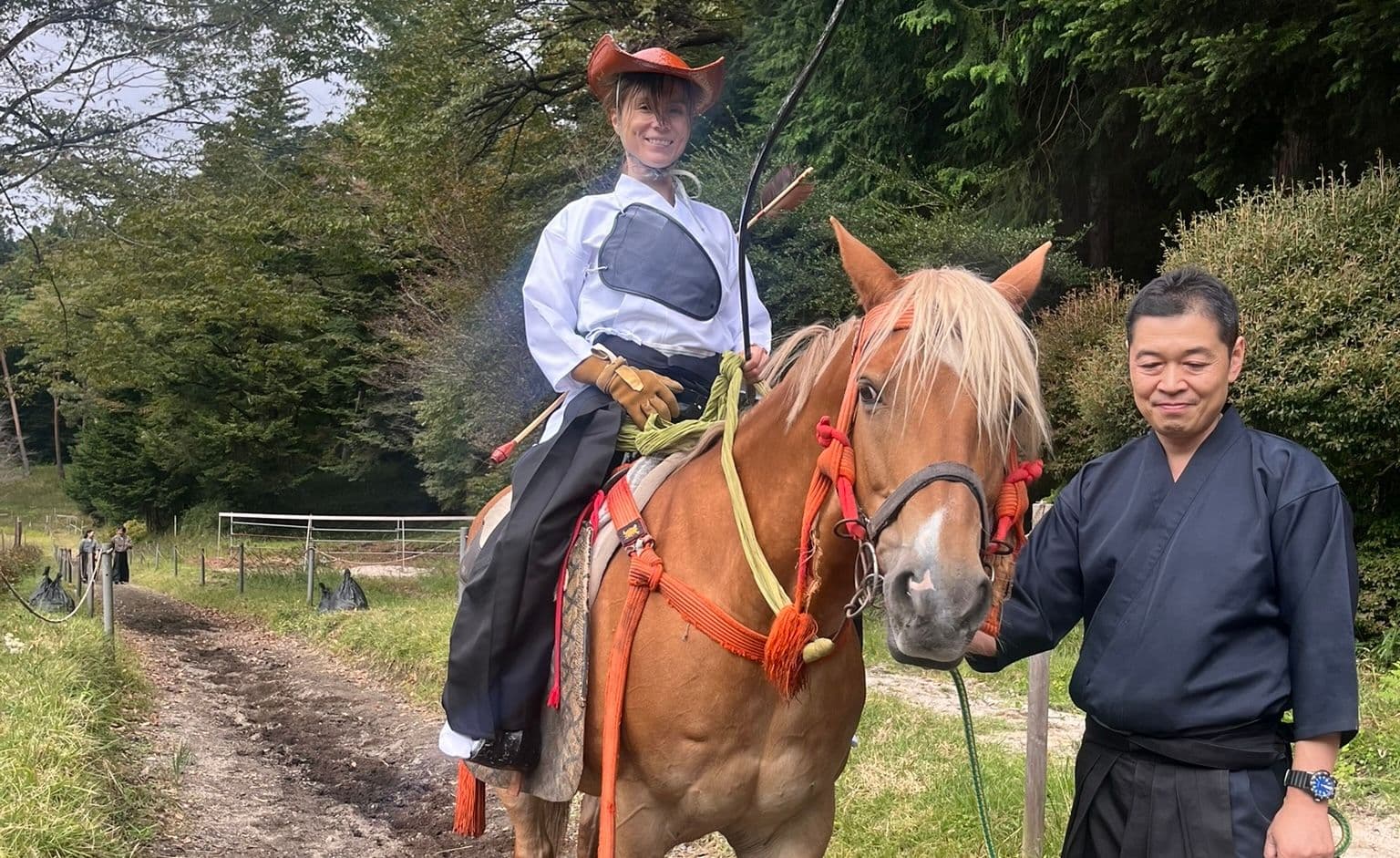
We walked over to the track where a horse was waiting tacked up and ready to go. Another fun factoid I learned was that they actually use real Edo-period saddles for the shrine ceremonies they perform! Unfortunately mine was just a reproduction.
For the riding portion, we did two rounds of walking past three targets while I tried to hit them. I did ok. It was supposed to be the end but the head trainer came out and said something about trotting. I was really happy about this as I've only had the ability to try shooting while trotting a few times before so it was nice to try it out again. Then we dismounted. I asked if I could say thank you to the horse and I got to tell it "Origato Gozaimasu". Then I was undressed and the experience was over.
The three hour experience started at 10AM and was over at 12:10PM.
Horses & Welfare
I saw no red flags, but also got to spend really little time with them. They clearly had paddocks, though no grass; there seemed to be an indoor stable, and they looked to be in good health. All horses appeared healthy and well-maintained.
I was worried after seeing a sacred horse by itself stuck in a small stall inside a shrine building the other day, neighing desperately. It almost made me call the thing off, thinking the horses might be treated the same way at Shogun Stables, but fortunately, they at least seem to have friends and turnout time.
Value for Money
At 48,000 yen, this experience was about $250, and given that it was barely over two hours, I'm going to say that's about $125 an hour. Which is honestly a lot. It was a private experience, which I guess could explain the premium, but I honestly would have preferred a group experience and thought I had signed up for that.
My main concern with value is that it really irks me when experiences end this much earlier than they advertised. I think they might have been preparing for the festival the next day, and hence the need to rush me, as afterwards I had tea next door and observed everyone that had been in the group with me rushing about frantically doing random things like unloading a newly arrived horse trailer and gathering tack. But really, they should not have scheduled my experience on a day they did not have time for me if that was the case.
Pros & Cons
Pros
- Authentic 800-year-old tradition preserved and practiced
- Professional instruction from knowledgeable staff
- Translation support provided
- Traditional costume experience
- Great footage provided
Cons
- Ended 50 minutes early (only 2hr 10min of 3 hours)
- Minimal actual riding time (~10-15 minutes total)
- Solo experience when expecting group (uncomfortable for introverts)
- Limited interaction with horses beyond brief ride
- No opportunity to give treats or spend time with horses
- If there's rain you'll be "riding" a wooden horse indoors
Final Verdict
Ok, so for a horse girlie there just wasn't enough horse time to give this a high rating. I'd rather have spent more time learning about horses in Japan than proper bowing technique, and given that we ended 50(!!) minutes early, I really feel like we could've spent more time practicing on the track to make it feel worthwhile. Even outside the saddle, it would've been nice to be able to interact with the horse and give it some treats after or be allowed to hang out with some of the other horses, or something. I'd say if you happen to be in Nikko and this sounds interesting, I definitely think it's worth stopping by, but don't be upset if you can't make it or whatever.
That said, I think that if you're interested in Japanese history, Samurai etiquette, etc. this is definitely worth way more than the 2 stars I'm giving it. I'm just writing this from my own perspective, but this isn't to mean that the experience itself was not great - it actually was, just not in the sense that a horse girl might fully appreciate.
I do have to point out that there is a mounted archery-only experience listed on their website that is cheaper and shorter. I figured doing both would give me a fuller experience, but maybe that's not the case, and doing the mounted archery only experience would have been more horse time.
I think what would have made this more amazing is to incorporate a hack in the nearby trails after the experience - the nature is so beautiful in Nikko and it's just too bad there are no horse trail options. Adding more saddle time and a tea/snack break would truly make it a day to remember for visitors.
If you're in Nikko and curious about traditional Japanese horseback archery, it's a fascinating window into Samurai culture — just manage your expectations about saddle time. With a little more riding and a scenic trail hack added afterwards, I think it could be an unforgettable experience.